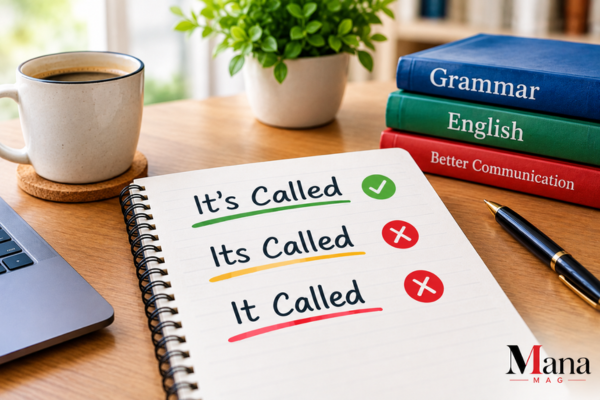
If you’re naming or identifying something, the correct phrase is “it’s called,” with an apostrophe. “Its called” (no apostrophe) is always wrong. “It called” is a completely different phrase that describes a past action, like a phone ringing, not a name.
That’s the whole rule in two sentences. But since one missing apostrophe is one of the most common typing slips in English, it’s worth understanding exactly why these three phrases work differently, so you stop having to guess every time you type them.
The Three Forms at a Glance
| Phrase | What it is | Example | Correct? |
| It’s called | Contraction of “it is called” | It’s called a thermostat. | Yes |
| Its called | Possessive “its” + verb (doesn’t work grammatically) | Its called a thermostat. | No, never |
| It called | Past tense of “to call” | It called for backup. | Yes, but rare |
If you remember nothing else, remember this: “its called” is never correct. It shows up constantly in casual writing and social media, but it’s a straightforward typo, not a legitimate alternate form.
Why “It’s Called” Is the One You Usually Want
“It’s” is a contraction, meaning it’s two words squeezed into one with an apostrophe standing in for the missing letters. It can mean either “it is” or “it has.”
- It’s raining. (It is raining.)
- It’s been three years. (It has been three years.)
When you use “it’s called,” you’re saying “it is called,” and that structure is what English uses to introduce a name or label for something. Think of it as the sentence pattern behind every definition you’ve ever read:
- A device that measures temperature is called a thermostat.
- The condition is called insomnia.
- What we now call the internet started out as a research network.
You can test whether “it’s” is correct by mentally swapping in “it is.” If the sentence still makes sense, you need the apostrophe.
- It’s called a violin. → It is called a violin. ✅ Makes sense, apostrophe stays.
- The dog wagged it’s tail. → The dog wagged it is tail. ❌ Doesn’t make sense, so this needs “its” instead.
That substitution test alone will fix the vast majority of it’s/its mistakes.
Why “Its” (No Apostrophe) Almost Never Works Here
“Its” is a possessive pronoun, in the same family as “his,” “her,” and “their.” None of those take an apostrophe, and neither does “its,” even though your instinct might tell you otherwise because apostrophes usually signal possession elsewhere in English (like “the dog’s bone”).
- The company raised its prices.
- The bird returned to its nest.
- Every recipe has its own quirks.
Here’s the trick that makes this stick: try swapping “its” for “his” or “her” in the sentence. If that swap still reads naturally, “its” is correct and gets no apostrophe.
- The team lost its momentum. → The team lost his momentum. (Sounds a little odd, but grammatically the swap works, confirming “its” is possessive.)
Since “its called” would require “called” to attach to a possessive noun with no verb to anchor it, the sentence structurally falls apart. There’s no version of English grammar where “its called” makes sense as a naming phrase. It’s simply the wrong word.
Why “It Called” Means Something Completely Different
“It called” drops the apostrophe on purpose, because here “it” is just a plain subject pronoun and “called” is a regular past-tense verb. This phrase describes something that performed the action of calling, not something that has a name.
- It called my phone twice this morning.
- The alarm system called for help automatically.
- Something called out from the other room.
This version shows up far less often than “it’s called,” mostly because we don’t usually describe non-human subjects as calling out loud unless we’re writing narrative prose, describing an automated system, or writing dialogue with a slightly poetic tone (“the wind called through the trees”). In technical or business writing, “it called” almost always refers to a phone, a computer process, or an automated function, something along the lines of a script that “called an API” or a system that “called for a restart.”
If you ever catch yourself writing “it called” to introduce a name, stop. That’s the tell that you actually needed “it’s called.”
“What Is This Called?” and Other Question Forms
A related search people run into constantly: how do you correctly ask for the name of something?
- Formal/full form: “What is this called?” or “What is it called?”
- Contracted/spoken form: “What’s this called?” or “What’s it called?”
Both versions are grammatically correct. The apostrophe in “what’s” replaces the letter “i” in “is,” exactly the same mechanism as “it’s.” The choice between them is purely about register: “what is it called” reads more formal or written, while “what’s it called” sounds like natural spoken English. Use whichever matches the tone of what you’re writing, but don’t mix both forms in the same paragraph.
One nuance worth knowing: some grammar resources describe this question as following a “passive” pattern, since the subject (the thing you’re asking about) is being named rather than doing something. That’s a helpful way to think about it, but you don’t need to memorize the label to use the phrase correctly. Just remember the question and its contraction behave exactly like “it’s called” does.
“X Is Called Y”: The Naming Pattern Behind Definitions
Outside of casual conversation, “is called” (without the contraction) shows up everywhere definitions and naming conventions are written: textbooks, product documentation, scientific writing, legal language.
- The process by which plants convert sunlight into energy is called photosynthesis.
- A legal document that transfers property after death is called a will.
- The condition where you can’t sleep is called insomnia.
This is the same underlying grammar as “it’s called,” just without the contraction and usually applied to naming something more formally, often right after describing what it does. It’s a genuinely useful pattern to know if you’re writing instructional content, technical documentation, or anything where you need to introduce a term for the first time. The standard order is: describe the thing first, then name it. Readers absorb definitions better when they get the concept before the label, rather than the label before the concept.
Formal vs. Informal Usage
Contractions like “it’s” are completely standard in spoken English, emails, blog posts, and fiction. Formal writing, like academic papers, legal documents, and some business reports, tends to spell things out in full.
| Context | Casual | Formal |
| Email to a colleague | It’s called quarterly reporting. | It is called quarterly reporting. |
| Academic paper | It’s known as the placebo effect. | It is known as the placebo effect. |
| Product description | It’s called the Starter Plan. | It is called the Starter Plan. |
Neither version is “more correct” grammatically. It’s a style choice tied to your audience and the formality of the document. Some style guides for academic and legal writing avoid contractions across the board, so if you’re writing a thesis or a contract, check your institution’s preferences before defaulting to contractions.
The Most Common Mistakes (and Quick Fixes)
Mistake 1: Dropping the apostrophe entirely. Wrong: Its called a compound sentence. Right: It’s called a compound sentence. Fix: Run the “it is” substitution test before you hit publish.
Mistake 2: Using “it called” to introduce a name. Wrong: It called a peninsula. Right: It’s called a peninsula. Fix: Ask yourself if “it” actually performed an action. A landmass can’t call anything, so this needs “it’s.”
Mistake 3: Adding an apostrophe to the possessive “its.” Wrong: The company changed it’s logo. Right: The company changed its logo. Fix: Swap in “his” or “her.” If that reads naturally, skip the apostrophe.
Mistake 4: Mixing formal and casual forms in the same piece. If you use “it’s called” in one paragraph and “it is called” in the next for no particular reason, it reads as inconsistent. Pick a register for your document and stick with it.
Three Memory Tricks Worth Keeping
- The substitution test. Swap “it’s” for “it is.” If the sentence holds up, you’re correct.
- The pronoun swap. Swap “its” for “his” or “her.” If that works, skip the apostrophe.
- The action check. If “it” is genuinely doing something (dialing, ringing, shouting), you’re in “it called” territory. If you’re naming or labeling something, you need “it’s called.”
Run any sentence through these three checks and you’ll rarely get this wrong again.
FAQ
Is “its called” ever correct? No. “Its called” is a grammatical error in every context. You either need “it’s called” (naming something) or “it called” (a past action), depending on your meaning.
What’s the difference between “it’s called” and “it is called”? Nothing in meaning. “It’s called” is simply the contracted, conversational version of “it is called.” Use whichever fits the formality of what you’re writing.
Can I use “it’s called” in academic writing? It’s grammatically fine, but many academic style guides discourage contractions in formal papers. When in doubt, spell out “it is called” for essays, theses, and research writing.
How do I remember when to use “its” without an apostrophe? Try replacing “its” with “his” or “her” in the sentence. If the sentence still makes sense, “its” is correct and takes no apostrophe.
Is “it called” grammatically correct? Yes, when “it” is the subject performing the action of calling, such as “it called for help” or “the alarm called out.” It’s just far less common than “it’s called” in everyday writing.
What’s the difference between “what is this called” and “what do you call this”? Both ask for a name, but “what is this called” focuses on the thing itself and its established name, while “what do you call this” puts the focus on the person answering and how they personally refer to it. Both are correct; the choice depends on which part of the sentence you want to emphasize.

Must See
-


Sports
/ 2 months agoLos Angeles Chargers vs Detroit Lions Match Player Stats: 2025 Hall of Fame Game
The Los Angeles Chargers defeated the Detroit Lions 34-7 in the 2025 NFL Hall...
By Magzine -


Sports
/ 2 months agoPittsburgh Pirates vs Mets Match Player Stats: August 2026 Game Breakdown
The Pittsburgh Pirates and New York Mets produced two very different games during their...
By Magzine -


Sports
/ 2 months agoGolden State Warriors vs Orlando Magic Match Player Stats, Box Score and Game Analysis
The Golden State Warriors beat the Orlando Magic 120-97 on December 22, 2025, at...
By Magzine