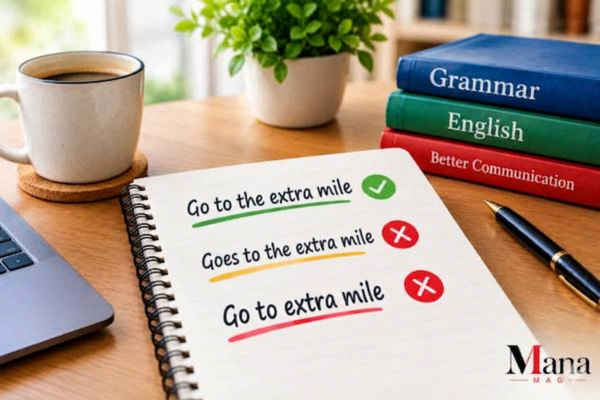
“Go the extra mile” means to put in more effort than is required or expected, usually to help someone or improve a result, without being asked to. If your coworker stays late to double-check a report nobody asked her to review, or a mechanic tightens a loose bolt he noticed while doing something else, that’s the phrase in action.
It’s one of the most-used phrases in performance reviews, cover letters, and customer service training, which is exactly why it can start to sound tired if you use it the same way every time. Below you’ll find where the phrase actually comes from, how to conjugate it correctly (go, goes, went, going), and a organized set of alternatives you can pull from depending on whether you’re writing something formal, casual, or personal.
Where the Phrase Comes From
“Go the extra mile” has a specific historical origin, not just a vague old-timey feel. It comes from Matthew 5:41 in the New Testament, part of the Sermon on the Mount, where Jesus tells his followers: “If anyone forces you to go one mile, go with him two.” At the time, Roman soldiers occupying Judea had the legal right to force a civilian to carry their gear for exactly one mile, no more. Jesus’s instruction was to voluntarily carry it a second mile, turning a forced obligation into a deliberate act of generosity.
The phrase stayed mostly in religious and literary use for centuries. Language historians note it didn’t become common in everyday English until around the 1930s, when it shifted from a moral teaching into the general-purpose motivational phrase people use today, disconnected from its biblical roots for most speakers. A 1957 British revue song by Joyce Grenfell titled “Ready… To Go the Extra Mile” is sometimes credited with helping popularize the modern usage.
Getting the Verb Form Right: Go, Goes, Went, Going
This trips people up more than you’d expect, especially non-native speakers searching for the correct past tense. Here’s the full conjugation:
| Form | When to use it | Example |
| Go the extra mile | Present tense, general statements or instructions | “We go the extra mile for every customer.” |
| Goes the extra mile | Third person singular, present tense | “She goes the extra mile on every project.” |
| Went the extra mile | Past tense, describing something already done | “He went the extra mile to fix it before the deadline.” |
| Going the extra mile | Present participle, used after “is/are/was/were” or as a gerund | “Going the extra mile is part of the job.” |
| Went extra mile | Common informal shorthand, technically missing “the” | Should be corrected to “went the extra mile” in formal writing |
Note that “went extra mile” (without “the”) shows up a lot in casual writing and search queries, but it’s grammatically incomplete. The definite article “the” belongs in the phrase: “went the extra mile,” not “went extra mile.” The same goes for a common typo some people search for: “extra milestone” is not a real variant of this idiom. If you’re looking for language about hitting achievement markers, that’s a separate concept (a milestone), not a rewording of this phrase.
What the Phrase Actually Implies (and What It Doesn’t)
Not every instance of hard work qualifies as “going the extra mile.” The phrase carries three specific implications:
- It’s voluntary. If your boss ordered you to stay late, that’s overtime, not going the extra mile. The effort has to come from personal initiative.
- It exceeds a clear baseline. There has to be a normal, expected level of effort for the extra part to mean anything. Telling someone they went the extra mile for doing their basic job description dilutes the compliment.
- It’s usually for someone else’s benefit. Most uses of the phrase describe effort that helps a customer, colleague, student, or family member, not effort spent purely on personal ambition (that’s closer to “pushing yourself” or “striving”).
Knowing these three conditions helps you use the phrase accurately instead of tossing it onto any instance of hard work, which is part of why it feels overused: people apply it to routine competence instead of genuine, above-and-beyond effort.
Is It Overused? A Quick Reality Check
Here’s something most guides won’t tell you directly: yes, in certain settings, “go the extra mile” has become a cliché. It shows up so often in job postings, LinkedIn posts, and company mission statements that it’s lost some of its punch. That doesn’t mean you should never use it. It means:
- In a resume or cover letter, use it sparingly, and only when you can immediately back it up with a concrete example. A hiring manager has read “I always go the extra mile” hundreds of times; a specific story lands better than the phrase itself.
- In spoken conversation or a handwritten thank-you note, the phrase still reads as sincere because tone and context carry more weight than in written business copy.
- In marketing copy or company values pages, it’s worth swapping in a more specific alternative so your brand doesn’t sound like every other brand.
Better Alternatives, Organized by Tone
Rather than one long undifferentiated list, here are alternatives grouped by the situation they actually fit best.
For Professional and Formal Writing
- Exceeded expectations
- Demonstrated exceptional initiative
- Delivered beyond scope
- Consistently overdelivered
- Took ownership beyond the assigned role
Example: “During Q3, she consistently overdelivered on client deliverables, often finishing projects ahead of schedule with additional recommendations included.”
For Everyday, Conversational Use
- Went out of their way
- Really stepped up
- Gave it everything
- Didn’t have to do that, but did anyway
- Took it further than anyone asked
Example: “Thanks for going out of your way to grab that for me, you really didn’t have to.”
For Customer Service and Client Relationships
- Turned a routine request into a great experience
- Anticipated what we needed before we asked
- Made sure we were taken care of
- Followed up without being asked
Example: “The support rep followed up two days later just to make sure the fix actually worked. That’s the kind of service that keeps us as customers.”
For Personal, Emotional, or Relationship Contexts
- Showed up when it mattered
- Gave more of themselves than the moment required
- Put their heart into it
- Never made me feel like a burden
Example: “You didn’t just help me move. You showed up at 6 a.m. with coffee and stayed until midnight. That’s more than anyone should ask of a friend.”
For Bold, High-Energy Contexts (Sports, Motivation, Leadership)
- Left everything on the field
- Refused to settle for good enough
- Pushed past the point most people stop
- Set a new standard for the team
Example: “Nobody told them to redesign the whole workflow, they just saw a better way and built it.”
When to Use the Idiom vs. When to Be Specific
A quick rule of thumb: use the idiom when you want a fast, familiar shorthand that everyone immediately understands. Use a specific description when you want to actually persuade someone, whether that’s a hiring manager, a customer, or a partner.
Compare these two:
- Generic: “Our team always goes the extra mile for clients.”
- Specific: “Last month, our support team rebuilt a client’s onboarding flow overnight, without being asked, because they noticed drop-off in the data.”
The second version does more work because it proves the claim instead of stating it. Save the idiom for quick, casual mentions, and reach for a specific example whenever the stakes are higher, like a performance review, a job application, or a testimonial.
Quick Reference Table
| Situation | Best Alternative |
| Job interview or resume | “Consistently exceeded expectations” + a specific example |
| Thank-you card | “You went out of your way, and it meant a lot” |
| Employee recognition email | “Demonstrated exceptional initiative on the Miller account” |
| Customer review response | “So glad our team could take care of you the way they did” |
| Casual text to a friend | “You really stepped up, thank you” |
Conclusion
“Go the extra mile” is a genuinely useful phrase with a real history behind it, but it works best when it’s earned and backed by specifics rather than dropped in as filler. Knowing the correct verb forms (go, goes, went, going, always with “the”) keeps your writing grammatically clean, and having a rotation of alternatives ready means you’re not repeating the same idiom in every email, review, or thank-you note you write. Match the phrase, or its substitute, to the tone of what you’re writing, and it’ll land the way it’s supposed to.
FAQ
What does “go the extra mile” mean exactly? It means voluntarily doing more than what’s expected or required, usually to help or benefit someone else, beyond simply meeting a baseline obligation.
Is it “went extra mile” or “went the extra mile”? The correct phrase includes the article “the”: “went the extra mile.” Dropping “the” is a common shorthand in casual speech but isn’t grammatically complete.
Where does the phrase come from? It originates from Matthew 5:41 in the Bible, where Jesus instructs followers to voluntarily carry a Roman soldier’s gear a second mile beyond the one mile they were legally required to carry, turning a forced obligation into a deliberate act of generosity.
Is “go the extra mile” a cliché? In heavily used business contexts like resumes and company mission statements, it can come across as generic. It still works well in casual and personal settings where sincerity matters more than originality.
What’s a more specific way to say someone went the extra mile at work? Instead of the general phrase, describe the actual action: what they did, why it wasn’t required, and what result it produced. Specificity is more persuasive than the idiom on its own.
Is “extra milestone” related to this phrase? No, that’s typically a typo or misremembering of “extra mile.” A milestone refers to a significant point of progress or achievement, which is a different concept entirely.

Must See
-


Sports
/ 2 months agoLos Angeles Chargers vs Detroit Lions Match Player Stats: 2025 Hall of Fame Game
The Los Angeles Chargers defeated the Detroit Lions 34-7 in the 2025 NFL Hall...
By Magzine -


Sports
/ 2 months agoPittsburgh Pirates vs Mets Match Player Stats: August 2026 Game Breakdown
The Pittsburgh Pirates and New York Mets produced two very different games during their...
By Magzine -


Sports
/ 2 months agoGolden State Warriors vs Orlando Magic Match Player Stats, Box Score and Game Analysis
The Golden State Warriors beat the Orlando Magic 120-97 on December 22, 2025, at...
By Magzine