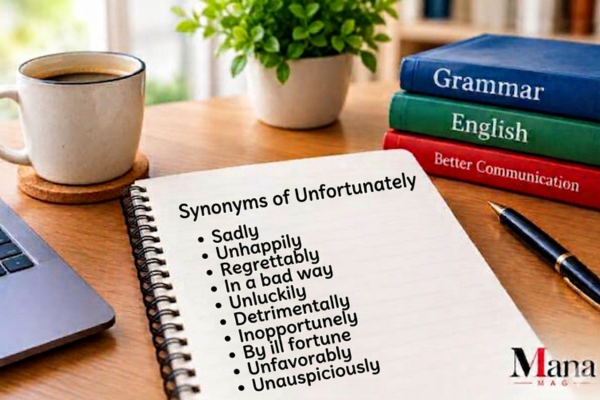
The best unfortunately synonym depends on what you want to communicate. “Regrettably” works well in formal emails, “sadly” fits personal situations, “unluckily” points to bad luck, and “I’m afraid” can soften disappointing news in conversation.
“Unfortunately” is an adverb used when a situation is sad, disappointing, regrettable, or creates a difficulty. Oxford defines it as a word used to indicate that a situation causes sadness or disappointment or puts someone in a difficult position.
If you need another word for unfortunately, the list below gives you practical choices with examples and tone notes. The goal is not to replace the word every time. Sometimes “unfortunately” is still the clearest option. The point is to choose an expression that matches the situation.
Quick List of Unfortunately Synonyms
Here are useful alternatives at a glance:
- Regrettably
- Sadly
- Unluckily
- Regretfully
- It is unfortunate that
- I’m afraid
- It’s a pity
- To my regret
- To our regret
- Disappointingly
- Alas
- To my dismay
- Lamentably
- Tragically
- Unhappily
- With regret
- Sad to say
- To my disappointment
- It is regrettable that
- Without success
- Unfortunately for…
- In an unfortunate turn of events
- Much to my disappointment
- Much to our regret
- With some regret
- It did not work out
- Things did not go as planned
- The situation is regrettable
- The outcome was disappointing
- We were unable to…
Not every expression has exactly the same meaning. Some describe sadness, some express regret, and others focus on disappointment or bad luck.
What Does “Unfortunately” Mean?
“Unfortunately” generally introduces information that the speaker considers bad, disappointing, sad, inconvenient, or regrettable. Cambridge gives the same core meaning and lists “sadly” and “alas” among related terms.
For example:
“Unfortunately, I cannot attend the meeting.”
The sentence tells the reader that the speaker regrets being unable to attend.
“Unfortunately, the tickets were sold out.”
Here, the word introduces an unwanted result.
“Unfortunately, we missed the deadline.”
The word signals disappointment about what happened.
The position of the word can also change:
“Unfortunately, we missed the train.”
“We missed the train, unfortunately.”
Both are grammatical. The first puts more attention on the disappointing news.
What Is Another Word for Unfortunately?
“Regrettably” is one of the closest alternatives to “unfortunately,” especially in formal writing.
For example:
“Unfortunately, we cannot approve your request.”
can become:
“Regrettably, we cannot approve your request.”
Both sentences communicate the same basic message. “Regrettably” gives the sentence a more formal tone. Dictionary sources list “regrettably,” “sadly,” and “unluckily” among direct synonyms of “unfortunately.”
But “regrettably” is not always the best choice. If you are talking about bad luck, “unluckily” can be more precise. If you are expressing grief, “sadly” can sound more natural.
30 Alternatives to “Unfortunately”
1. Regrettably
“Regrettably” is one of the closest formal substitutes.
Example:
“Regrettably, we cannot offer you a refund.”
Use it for:
- Business emails
- Formal letters
- Official notices
- Professional refusals
It expresses regret without sounding overly emotional.
2. Sadly
“Sadly” works when the situation involves genuine sadness or disappointment.
Example:
“Sadly, we will not be able to attend the ceremony.”
It is more personal than “regrettably.”
Another example:
“Sadly, the old building will be demolished.”
Use “sadly” when you want the sentence to carry some emotional weight.
3. Unluckily
“Unluckily” focuses on bad luck or chance.
Example:
“Unluckily, we arrived just after the store closed.”
This works well in casual conversation, although “unfortunately” is generally more common in everyday English. Thesaurus sources list “unluckily” as a direct synonym.
4. Regretfully
“Regretfully” can express personal regret, especially when someone is making a decision or taking responsibility.
Example:
“Regretfully, I must decline the invitation.”
It fits formal letters and personal statements.
There is a useful distinction between “regrettably” and “regretfully.” “Regrettably” often comments on an unfortunate situation, while “regretfully” can put more attention on the speaker’s feeling of regret.
5. It Is Unfortunate That
This is a direct sentence-level alternative.
Example:
“Unfortunately, the project was canceled.”
becomes:
“It is unfortunate that the project was canceled.”
This version works well in formal reports, discussions, and professional writing.
6. I’m Afraid
“I’m afraid” is useful when giving someone disappointing news.
Example:
“I’m afraid we cannot accept your application.”
It sounds softer and more conversational than:
“We cannot accept your application.”
This phrase is common in polite English, especially when declining requests or correcting expectations.
7. It’s a Pity
“It’s a pity” expresses mild disappointment or sympathy.
Example:
“It’s a pity you could not join us.”
This sounds friendly and conversational.
It is less suitable when the situation is extremely serious. You would not normally use “It’s a pity” for a major tragedy.
8. To My Regret
“To my regret” shows that the speaker personally regrets what happened.
Example:
“To my regret, I was unable to attend the meeting.”
This has a formal and personal tone.
9. To Our Regret
Use “to our regret” when speaking for a group or organization.
Example:
“To our regret, the event has been canceled.”
This works in formal customer communication and organizational announcements.
10. Disappointingly
“Disappointingly” focuses on an outcome that failed to meet expectations.
Example:
“Disappointingly, the new product received poor reviews.”
This is useful when the main emotion is disappointment rather than sadness.
11. Alas
“Alas” is an old-fashioned or literary alternative.
Example:
“Alas, the opportunity had already passed.”
It can sound dramatic, humorous, poetic, or theatrical depending on context.
Avoid it in ordinary business emails unless you intentionally want a playful tone.
12. To My Dismay
“To my dismay” shows personal disappointment, surprise, or concern.
Example:
“To my dismay, the documents had disappeared.”
This is stronger and more personal than “unfortunately.”
It works particularly well in storytelling and reflective writing.
13. Lamentably
“Lamentably” expresses sorrow or regret about an undesirable situation.
Example:
“Lamentably, the historic building was destroyed.”
The word has a formal and literary tone.
It is less common in everyday conversation, so use it when the context supports that style.
14. Tragically
“Tragically” should be reserved for genuinely tragic situations.
Example:
“Tragically, several people lost their lives.”
It is not a general replacement for “unfortunately.”
For example, this sounds excessive:
“Tragically, my favorite restaurant was closed.”
“Unfortunately, my favorite restaurant was closed.”
The second sentence fits the situation better.
15. Unhappily
“Unhappily” can mean unfortunately, although the word often carries a more literary tone.
Example:
“Unhappily, the agreement was never completed.”
It is less common in modern everyday speech than “unfortunately” or “sadly.”
16. With Regret
“With regret” is useful when communicating a formal refusal or decision.
Example:
“With regret, we must decline your proposal.”
It sounds professional and controlled.
17. Sad to Say
“Sad to say” introduces disappointing information.
Example:
“Sad to say, the restaurant has closed permanently.”
It has a conversational or reflective tone.
18. To My Disappointment
Use this when you want to make your personal disappointment clear.
Example:
“To my disappointment, the application was rejected.”
Unlike “unfortunately,” this phrase clearly identifies the speaker’s emotional response.
19. It Is Regrettable That
This is a formal alternative.
Example:
“It is regrettable that the agreement could not be reached.”
It fits reports, official statements, and formal correspondence.
20. Without Success
“Without success” is different from a direct synonym because it focuses on an unsuccessful attempt.
Example:
“We tried to contact the supplier without success.”
It is useful in factual, professional, and technical writing.
Do not use it when the issue is simply sad or unfortunate.
21. Unfortunately for…
Sometimes the best alternative is to restructure the sentence.
Example:
“Unfortunately for the team, the match was canceled.”
You can write:
“The cancellation was a setback for the team.”
This removes the adverb completely while preserving the main idea.
22. In an Unfortunate Turn of Events
This phrase describes an unexpected negative development.
Example:
“In an unfortunate turn of events, the event had to be canceled.”
It works in storytelling, news-style writing, and formal commentary.
It is longer than “unfortunately,” so do not use it when a simple sentence will do.
23. Much to My Disappointment
This expression strongly highlights personal disappointment.
Example:
“Much to my disappointment, the store had closed before I arrived.”
It works well in personal writing and storytelling.
24. Much to Our Regret
This version works for groups or organizations.
Example:
“Much to our regret, we cannot continue the partnership.”
It carries more emotional weight than a simple “unfortunately.”
25. With Some Regret
“With some regret” communicates reluctance.
Example:
“With some regret, I have decided to leave the organization.”
This is useful when a decision is difficult but necessary.
26. It Did Not Work Out
This is a casual alternative when something failed or ended differently from what was expected.
Example:
“Unfortunately, the deal fell through.”
could become:
“The deal did not work out.”
It sounds natural in conversation and informal writing.
27. Things Did Not Go as Planned
Use this when an event or project produced an unwanted result.
Example:
“Unfortunately, things did not go as planned.”
You can remove the first word:
“Things did not go as planned.”
This sounds natural and avoids unnecessary repetition.
28. The Situation Is Regrettable
This is a formal way to describe an undesirable situation.
Example:
“The situation is regrettable, but the decision cannot be changed.”
It fits official or professional communication.
29. The Outcome Was Disappointing
This phrase works when expectations were not met.
Example:
“Unfortunately, the results were disappointing.”
can become:
“The outcome was disappointing.”
The second version is more direct and focuses on the result.
30. We Were Unable To…
Sometimes the best alternative to “unfortunately” is no synonym at all.
Instead of:
“Unfortunately, we were unable to process your request.”
write:
“We were unable to process your request.”
This is often clearer in business writing. If the reason for the inability is already obvious, “unfortunately” can add little information.
Best Unfortunately Synonyms for Professional Emails
If you are writing a professional email, choose your expression based on the message.
| Situation | Good choice | Example |
| Formal refusal | Regrettably | Regrettably, we cannot approve the request. |
| Polite bad news | I’m afraid | I’m afraid we cannot meet the deadline. |
| Formal decision | With regret | With regret, we must decline the proposal. |
| Company response | To our regret | To our regret, the shipment was delayed. |
| Disappointing result | Disappointingly | Disappointingly, the project did not meet its targets. |
| Direct communication | We were unable to | We were unable to process the payment. |
In many professional emails, removing the word entirely produces the clearest result.
Compare:
“Unfortunately, we cannot provide a refund.”
“We cannot provide a refund under the terms of the agreement.”
The second sentence gives the reader useful information instead of simply labeling the situation as unfortunate.
Another Way to Say Unfortunately in an Email
Here are practical replacements for common email situations.
Rejecting a request
Instead of:
“Unfortunately, we cannot approve your request.”
Try:
“Regrettably, we cannot approve your request.”
Or:
“After reviewing your request, we are unable to approve it.”
The second version is direct and neutral.
Declining an invitation
Instead of:
“Unfortunately, I cannot attend.”
Try:
“Regretfully, I will not be able to attend.”
Or:
“I’m afraid I will not be able to attend.”
Giving a delay update
Instead of:
“Unfortunately, your order has been delayed.”
Try:
“We regret to inform you that your order has been delayed.”
Or:
“Your order has been delayed due to a supply issue.”
The second option gives the reader a reason, which can be more useful.
Rejecting an application
Instead of:
“Unfortunately, your application was not successful.”
Try:
“Regrettably, your application was not successful on this occasion.”
For a more direct style:
“We are unable to offer you a position at this time.”
Another Way to Say Unfortunately in a Casual Conversation
Casual conversations do not always need a formal synonym.
You could say:
“Sadly, I can’t make it.”
“I’m afraid I can’t come.”
“It’s a pity we missed the show.”
“Unfortunately, that won’t work.”
“Looks like we missed our chance.”
“The timing didn’t work out.”
“Things didn’t go as planned.”
These options sound more natural than forcing a formal word into an everyday conversation.
Unfortunately Synonyms by Tone
Choosing a synonym is easier when you first decide how the sentence should sound.
Formal
Use:
- Regrettably
- With regret
- It is regrettable that
- To our regret
- To my regret
Example:
“Regrettably, the committee cannot approve the proposal.”
Professional but friendly
Use:
- I’m afraid
- We were unable to
- It did not work out
- It is unfortunate that
Example:
“I’m afraid we cannot meet the requested delivery date.”
Personal
Use:
- Sadly
- To my disappointment
- To my regret
- Much to my disappointment
Example:
“Sadly, I won’t be able to join you.”
Casual
Use:
- It’s a pity
- Unluckily
- Things didn’t work out
- I’m afraid
Example:
“It’s a pity you couldn’t come.”
Literary or dramatic
Use:
- Alas
- Lamentably
- Tragically
- To my dismay
Example:
“Alas, the opportunity was gone.”
These words can sound unnatural in ordinary business communication, so context matters.
Unfortunately vs Regrettably
These two words are close in meaning.
“Unfortunately” is broad and common.
“Regrettably” sounds more formal and directly signals regret.
Compare:
“Unfortunately, we cannot accept your application.”
“Regrettably, we cannot accept your application.”
Both are correct. The second sounds more official.
Oxford lists “regrettably” as a synonym for “unfortunately,” which supports using the two in closely related contexts.
Unfortunately vs Sadly
“Sadly” places more attention on sadness.
“Unfortunately” can describe bad luck, inconvenience, disappointment, or an unwanted outcome without necessarily expressing deep emotion.
Compare:
“Unfortunately, the flight was canceled.”
“Sadly, the flight was canceled.”
The first sounds neutral. The second gives the cancellation a more emotional tone.
For serious personal loss, “sadly” can feel more natural.
Unfortunately vs Unluckily
“Unluckily” specifically points toward bad luck.
For example:
“Unluckily, I arrived five minutes after the store closed.”
“Unfortunately, I arrived five minutes after the store closed.”
Both work. “Unluckily” makes chance feel more central.
Merriam-Webster and Collins both list “unluckily” among words related to “unfortunately.”
Unfortunately vs Regretfully
“Regretfully” can suggest that the speaker personally feels regret.
For example:
“Regretfully, I must decline the offer.”
This makes the speaker’s position more personal.
“Regrettably, the offer has expired.”
This comments more directly on the situation.
The difference is small, and everyday usage can overlap.
How to Choose the Right Alternative
Before replacing “unfortunately,” ask what your sentence is actually doing.
Is the situation sad?
Use “sadly.”
Is the result caused by bad luck?
Use “unluckily.”
Are you expressing formal regret?
Use “regrettably.”
Are you delivering bad news politely?
Use “I’m afraid.”
Did an effort fail?
Use “without success.”
Did expectations fall short?
Use “disappointingly.”
Are you describing a serious tragedy?
Use “tragically.”
Are you writing creatively?
“Alas” or “lamentably” can work.
This approach produces better writing than picking a synonym simply because it sounds more sophisticated.
When You Should Keep “Unfortunately”
There is no rule saying that you need to replace “unfortunately.”
Sometimes it is the best word.
For example:
“Unfortunately, the store is closed.”
This is simple and natural.
Replacing it with:
“Lamentably, the store is closed.”
would make the sentence sound strange.
Likewise:
“Unfortunately, I forgot my wallet.”
is more natural than:
“Regrettably, I forgot my wallet.”
The best vocabulary choice is the one that fits the situation. A synonym should make the sentence clearer or better suited to its audience, not simply make the language sound different.
A Better Way to Avoid Repeating “Unfortunately”
If you notice that you use “unfortunately” several times in an email or article, do not replace every occurrence with a synonym.
Instead, change the sentence structure.
For example:
“Unfortunately, we cannot attend the meeting.”
can become:
“We will not be able to attend the meeting.”
Another example:
“Unfortunately, the project was delayed.”
can become:
“The project was delayed because the supplier shipped the materials late.”
The second version gives the reader more information.
This is often better than replacing one adverb with another.
Final Takeaway
The best unfortunately synonym depends on tone and meaning.
Use “regrettably” for formal communication. Choose “sadly” for personal or emotional situations. Use “unluckily” when bad luck is the main idea. “I’m afraid” works well when you need to deliver disappointing news politely. “Disappointingly” fits results that failed to meet expectations.
And sometimes the strongest alternative is no synonym at all. Simply state what happened.
Instead of:
“Unfortunately, we cannot approve your request.”
write:
“We cannot approve your request because the application is incomplete.”
Clear writing does not require a different word every time. It requires the right word for the message.
FAQ
What is the best synonym for unfortunately?
“Regrettably” is one of the closest synonyms and works well in formal writing. Other choices include “sadly,” “unluckily,” “regretfully,” and “it is unfortunate that,” depending on the context.
What is another word for unfortunately in professional writing?
“Regrettably,” “with regret,” “to our regret,” and “I’m afraid” are useful choices. “Regrettably” is especially suitable for formal emails and business communication.
What is another way to say unfortunately in an email?
You can write “regrettably,” “I’m afraid,” “with regret,” or “we were unable to.” In many cases, removing “unfortunately” and stating the reason directly creates a clearer email.
What is a polite way to say unfortunately?
“I’m afraid” is a polite conversational option. “Regrettably” works better for formal communication.
Example:
“I’m afraid we cannot accommodate your request.”
What is a formal word for unfortunately?
“Regrettably” is one of the most common formal alternatives. “Lamentably” and “it is regrettable that” are more formal but less common in everyday business writing.
What is a casual synonym for unfortunately?
“Sadly,” “unluckily,” and “it’s a pity” can work in casual situations. “Sadly” is especially useful when the situation involves genuine sadness.
Can I use sadly instead of unfortunately?
Yes, when the situation calls for a more emotional tone.
“Unfortunately, we missed the train.”
“Sadly, we missed the train.”
Both are correct, but “sadly” places more attention on the emotional side of the situation.
Can regrettably replace unfortunately?
Yes. “Regrettably” is a direct and formal alternative to “unfortunately.” Both can introduce disappointing or undesirable information.
Is “unluckily” a synonym for unfortunately?
Yes. “Unluckily” is used when an unwanted result is connected to bad luck or chance. It is less common than “unfortunately” in everyday English.
What can I say instead of unfortunately when rejecting someone?
For formal writing, try:
“Regrettably, we cannot accept your application.”
“We are unable to offer you a position at this time.”
“With regret, we must decline your request.”
The last two options avoid using a direct synonym.
What can I say instead of unfortunately when giving bad news?
Use “I’m afraid,” “regrettably,” “sadly,” or “it is unfortunate that,” depending on the situation.
Example:
“I’m afraid the meeting has been canceled.”
Is “alas” another word for unfortunately?
Yes, but “alas” has an old-fashioned, literary, or dramatic tone. Collins lists “alas” among synonyms of “unfortunately.”
What is the opposite of unfortunately?
The common opposite is “fortunately.” “Luckily” can also work in many sentences. Cambridge lists “fortunately” and “luckily” as opposites of “unfortunately.”
Should I avoid using unfortunately in professional writing?
No. “Unfortunately” is grammatically correct and widely used. The issue is repetition, not correctness. If you use the word several times, vary the sentence structure or choose a more precise expression where appropriate.

Must See
-


Sports
/ 2 months agoLos Angeles Chargers vs Detroit Lions Match Player Stats: 2025 Hall of Fame Game
The Los Angeles Chargers defeated the Detroit Lions 34-7 in the 2025 NFL Hall...
By Magzine -


Sports
/ 2 months agoPittsburgh Pirates vs Mets Match Player Stats: August 2026 Game Breakdown
The Pittsburgh Pirates and New York Mets produced two very different games during their...
By Magzine -


Sports
/ 2 months agoGolden State Warriors vs Orlando Magic Match Player Stats, Box Score and Game Analysis
The Golden State Warriors beat the Orlando Magic 120-97 on December 22, 2025, at...
By Magzine